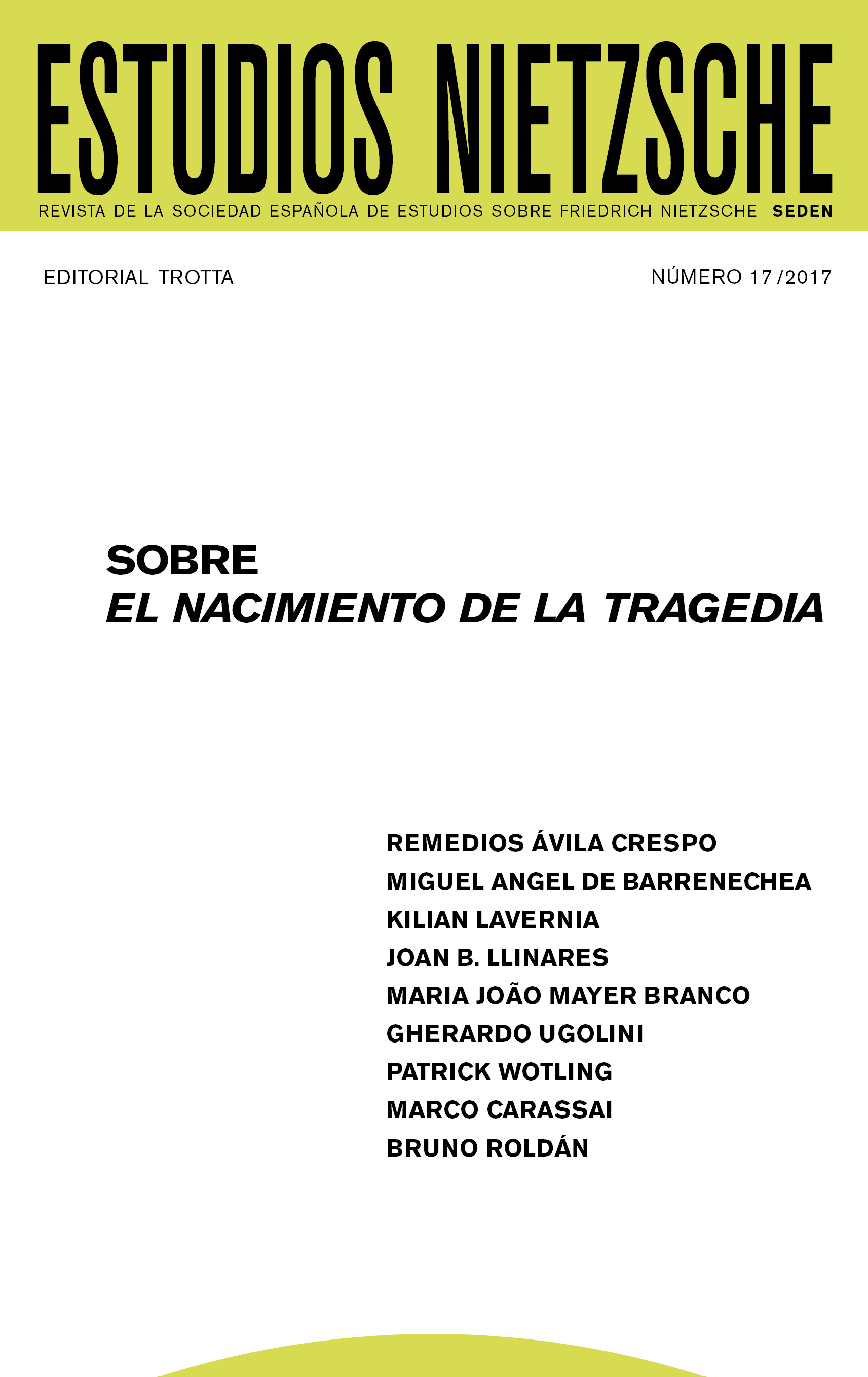
Gestation and structure of The Birth of Tragedy of F. Nietzsche
DOI:
https://doi.org/10.24310/EstudiosNIETen.vi17.10842Keywords:
Nietzsche, tragedy, sourcesAbstract
This article intends to remove the false image of this first work of Nietzsche as if it were a hurried and heteronomous text, edited to satisfy public opinion by the early appointment of professor of classical philology at Basel. In order to do so, he explains in detail his gestation process, his abundant sources, the various writings that prepared it, the search for his title and the triple hybridization of the structure. The commentaries
provided by the correspondence of the philosopher are also quoted and analyzed, and the long traces of this book in the Nietzschean legacy are explained.
Downloads
References
Colli, G., Introducción a Nietzsche, trad. de R. Medina, México: Folios Ediciones, 1983.
Nietzsche, F., Obras Completas, I-IV (OC ). Director ed. Diego Sánchez Meca. Madrid: Tecnos, 2011-2016
Nietzsche, F., Correspondencia I-VI. (CO). Director ed. Luis E. de Santiago Guervós. Madrid : Trotta, 2005- 2012.
Nietzsche, F., Fragmentos Póstumos I-IV (FP). Director ed. Diego Sánchez Meca. Madrid: Tecnos, 2006-2010.
Pórtulas, J., “Una vasta mitología”, en NIETZSCHE, F., El naixement de la tragèdia, trad. De de M. Carbonell, Martorell: Adesiara, 2011.
Ries, w., die geburt der tragödie, munich: dtv, 1999.
Schmidt, J. Kommentar zu Nietzsches Die Geburt der Tragödie, Berlin/Boston, W. de Gruyter, 2012.
Silk, M., Stern, J. P., Nietzsche on Tragedy, Cambridge: Cambridge University Press, 1981.
Dimensions
Citations




Issue
Section
License
As of issue 21 (2021) this journal is published only in open access (diamond route).
From that number 21, like the previous numbers published in NIETZSCHE STUDIES, they are subject to the Creative Commons Acknowledgment-NoComercia-ShareIgual 4.0 license, the full text of which can be consulted at <http://creativecommons.org/licenses/by-nc-sa/4.0 >
It is the responsibility of the authors to obtain the necessary permissions of the images that are subject to copyright.
This work is licensed under a Creative Commons Attribution-NonCommercial-ShareAlike 4.0 International License.
Copyright generates two different rights: moral rights and patrimonial rights that EJFB recognizes and respects. Moral rights are those relating to the recognition of the authorship. They are rights of a personal nature that are perpetual, inalienable, unseizable and imprescriptible as consequence of the indivisible union of the author and his/her work.
Patrimonial rights are those that can be derived from the reproduction, distribution, adaptation or communication of the work, among others.

11.png)
