
An Attempt at Self-Criticism, a genealogical perspective on the first work of Nietzsche
DOI:
https://doi.org/10.24310/EstudiosNIETen.vi17.10840Keywords:
self-criticism, genealogy, tragedy, medical-philosopherAbstract
In this paper my purpose is to investigate the well known «An attemp at self-criticism», preface or afterword to The birth of tragedy added by Nietzsche sixteen years after the first edition of that inaugural work. I will try to show that the German thinker, on this oportunity, pretends to use himself as material for his «medical philosophers» method, using a clinic or genealogic observation about the deepest motivations envolved
in the genesis of his youth book. From this interpretative proposal, he was trying to detect historical constraits and also political, artistic and cutural influences that incided in such an original and apparently extemporaneous book. In addition, his genealogic flair lids him far beyond: to figure out the personal and hidden impulses that afected this work and to speak on his own health condition together with his vital instincts that pushed him to create a book in which he questions the values, ideals and fundamental concepts of his generation.
Downloads
References
Assoun, P. L., Freud y Nietzsche, México: 1984.
Barrenechea, M. A., Nietzsche e o corpo, Rio de Janeiro: 7Letras, 2009.
Eugen Fink, Eugen, A filosofia de Nietzsche, Trad. J. L. Duarte Peixoto, Lisboa: Presença, 1983.
Lemm, Vanessa, Nietzsche Animal Philosophy: culture, politics, and the animality of the human being, Nova York:
Fordham University Press, 2009.
Löwith, K., «Nietzsche e a completude do ateísmo», en S. Marton, Nietzsche hoje, São Paulo: Brasiliense, 1985.
Machado, Roberto, Nietzsche e a polêmica sobre O nascimento da tragédia, Rio de Janeiro: Zahar, 2005.
Nietzsche, F., Obras Completas, I-IV (OC ). Director ed. Diego Sánchez Meca. Madrid: Tecnos, 2011-2016
Nietzsche, F., Correspondencia I-VI. (CO). Director ed. Luis E. de Santiago Guervós. Madrid : Trotta, 2005- 2012.
Nietzsche, F., Fragmentos Póstumos I-IV (FP). Director ed. Diego Sánchez Meca. Madrid: Tecnos, 2006-2010.
Wotling, Patrick, Nietzsche et le problème de la civilization, París: PUF, 1985.
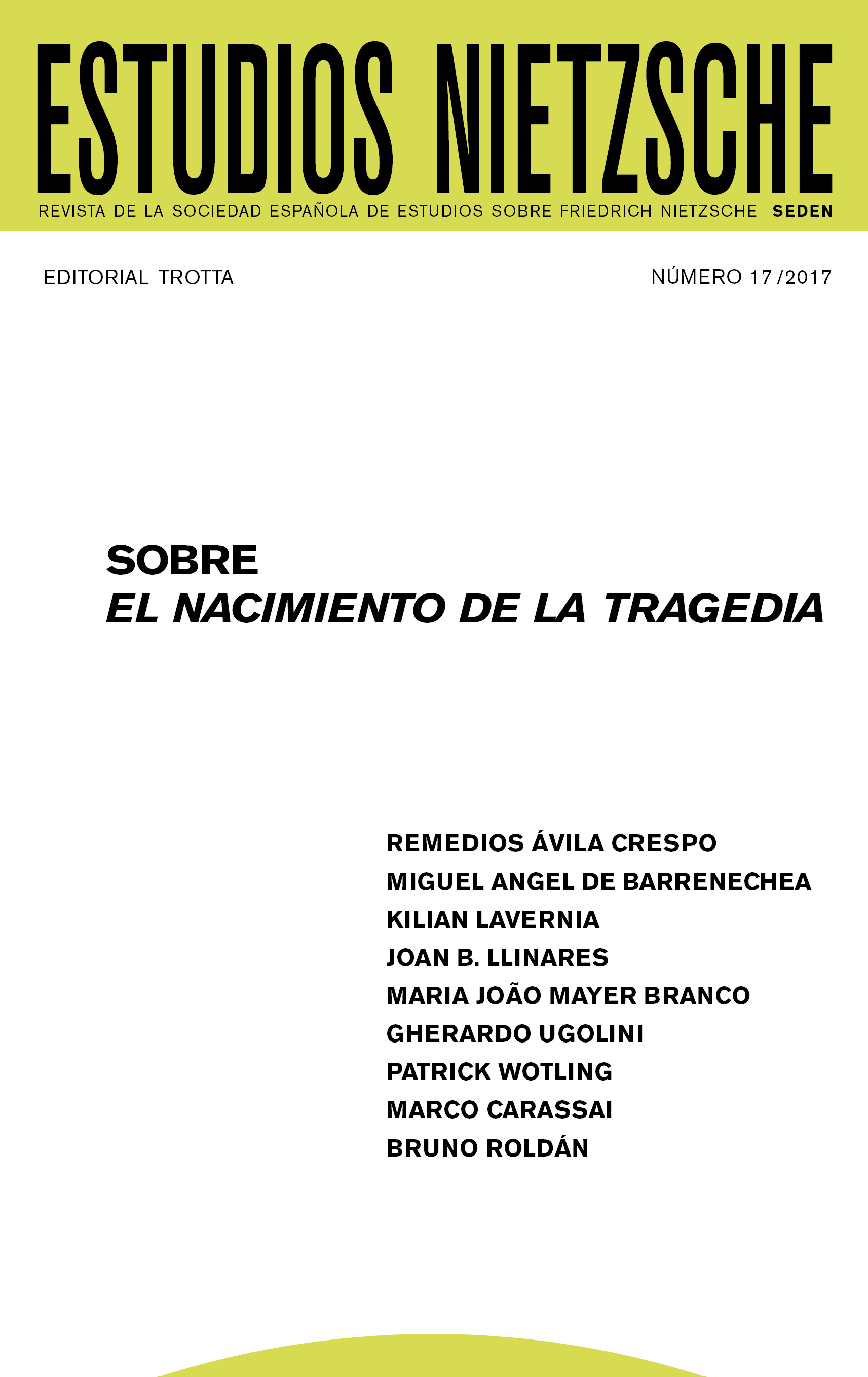
Downloads
Dimensions
Citations




Issue
Section
License
As of issue 21 (2021) this journal is published only in open access (diamond route).
From that number 21, like the previous numbers published in NIETZSCHE STUDIES, they are subject to the Creative Commons Acknowledgment-NoComercia-ShareIgual 4.0 license, the full text of which can be consulted at <http://creativecommons.org/licenses/by-nc-sa/4.0 >
It is the responsibility of the authors to obtain the necessary permissions of the images that are subject to copyright.
This work is licensed under a Creative Commons Attribution-NonCommercial-ShareAlike 4.0 International License.
Copyright generates two different rights: moral rights and patrimonial rights that EJFB recognizes and respects. Moral rights are those relating to the recognition of the authorship. They are rights of a personal nature that are perpetual, inalienable, unseizable and imprescriptible as consequence of the indivisible union of the author and his/her work.
Patrimonial rights are those that can be derived from the reproduction, distribution, adaptation or communication of the work, among others.

11.png)
