Engineering the biosphere through synthetic organisms: an alternative to climate change
Keywords:
Ecological engineering, synthetic biology, climate changeAbstract
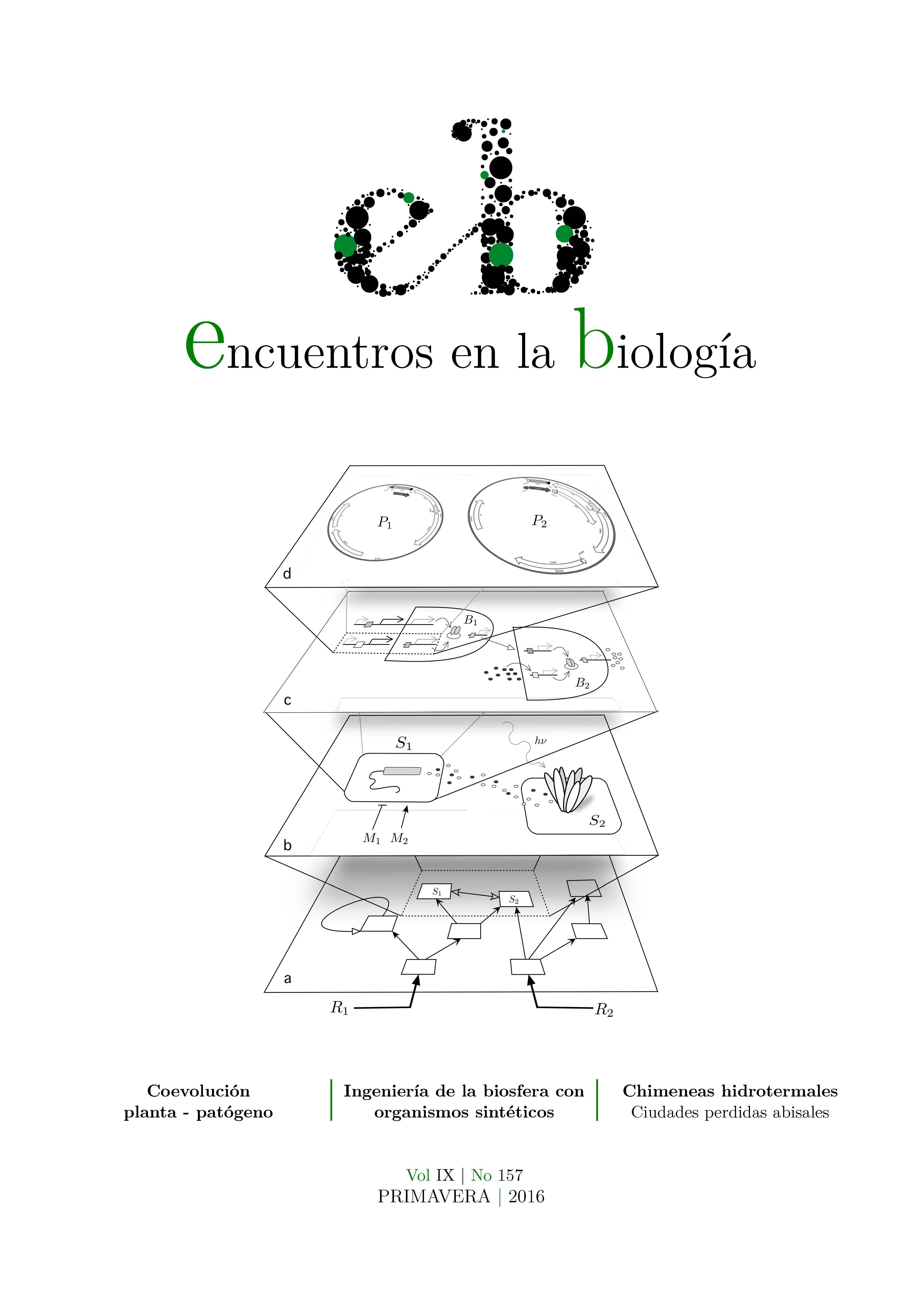
Our planet is experiencing an accelerated process of change associated to a variety of anthropogenic phenomena. The future of this transformation is uncertain, but there is general agreement about its negative unfolding that might threaten our own survival. Furthermore, the pace of the expected changes is likely to be abrupt: catastrophic shifts might be the most likely outcome of this ongoing, apparently slow process, associated to carbon dioxide accumulation or ecosystem degradation. What we propose as an alternative to this possible future is the design of synthetic organisms, capable of reproducing and expanding to large geographic scales with the goal of achieving a long term or a transient restoration of ecosystem-level homeostasis. Such a regional or even planetary scale engineering would have to deal with the complexity of our biosphere. It will require not only a proper design of organisms but also understanding their place within ecological networks and their evolvability. This is a likely future scenario that will require integration of ideas coming from currently weakly connected domains, including synthetic biology, ecological and genome engineering, evolutionary theory, climate science, biogeography and invasion ecology, among others.
Downloads
References
Solé RV. Bioengineering the biosphere. Ecol Complex., 22: 40–49. 2015
Solé RV, Montañez R, Durán-Nebreda S. Synthetic circuit designs for earth terraformation. Biology Direct, 10: DOI 10.1186/s13062-015-0064-7. 2015.
Downloads
Published
Dimensions
Issue
Section
License
Esta obra está bajo licencia internacional Creative Commons Reconocimiento-NoComercial-CompartirIgual 4.0.
Esta revista provee acceso libre inmediato a su contenido bajo el principio de hacer disponible gratuitamente la investigación al público. Todos los contenidos publicados en Encuentros en la Bilogía están sujetos a la licencia Creative Commons Reconocimento-NoComercia-Compartirigual 4.0 cuyo texto completo puede consultar en <http://creativecommons.org/licenses/by-nc-sa/4.0>
Se pueden copiar, usar, difundir, transmitir y exponer públicamente, siempre que:
Se cite la autoría y la fuente original de su publicación (revista, editorial y URL de la obra).
No se usen para fines comerciales.
Se mencione la existencia y especificaciones de esta licencia de uso
Los derechos de autor son de dos clases: morales y patrimoniales. Los derechos morales son prerrogativas perpetuas, irrenunciables, intransferibles, inalienables, inembargables e imprescriptibles. De acuerdo con la legislación de derechos de autor, Encuentros en la Biología reconoce y respeta el derecho moral de los autores/as, así como la titularidad del derecho patrimonial, el cual será cedido a la Universidad de Málaga para su difusión en acceso abierto. Los derechos patrimoniales, se refieren a los beneficios que se obtienen por el uso o divulgación de las obras. Encuentros en la Biología se publica en open access y queda autorizada en exclusiva para realizar o autorizar por cualquier medio el uso, distribución, divulgación, reproducción, adaptación, traducción o transformación de la obra.
Es responsabilidad de los autores/as obtener los permisos necesarios de las imágenes que están sujetas a derechos de autor.
Los autores/as cuyas contribuciones sean aceptadas para su publicación en esta revista conservarán el derecho no exclusivo de utilizar sus contribuciones con fines académicos, de investigación y educativos, incluyendo el auto-archivo o depósito en repositorios de acceso abierto de cualquier tipo.
La edición electrónica de esta revista esta editada por la Editorial de la Universidad de Málaga (UmaEditorial), siendo necesario citar la procedencia en cualquier reproducción parcial o total.
