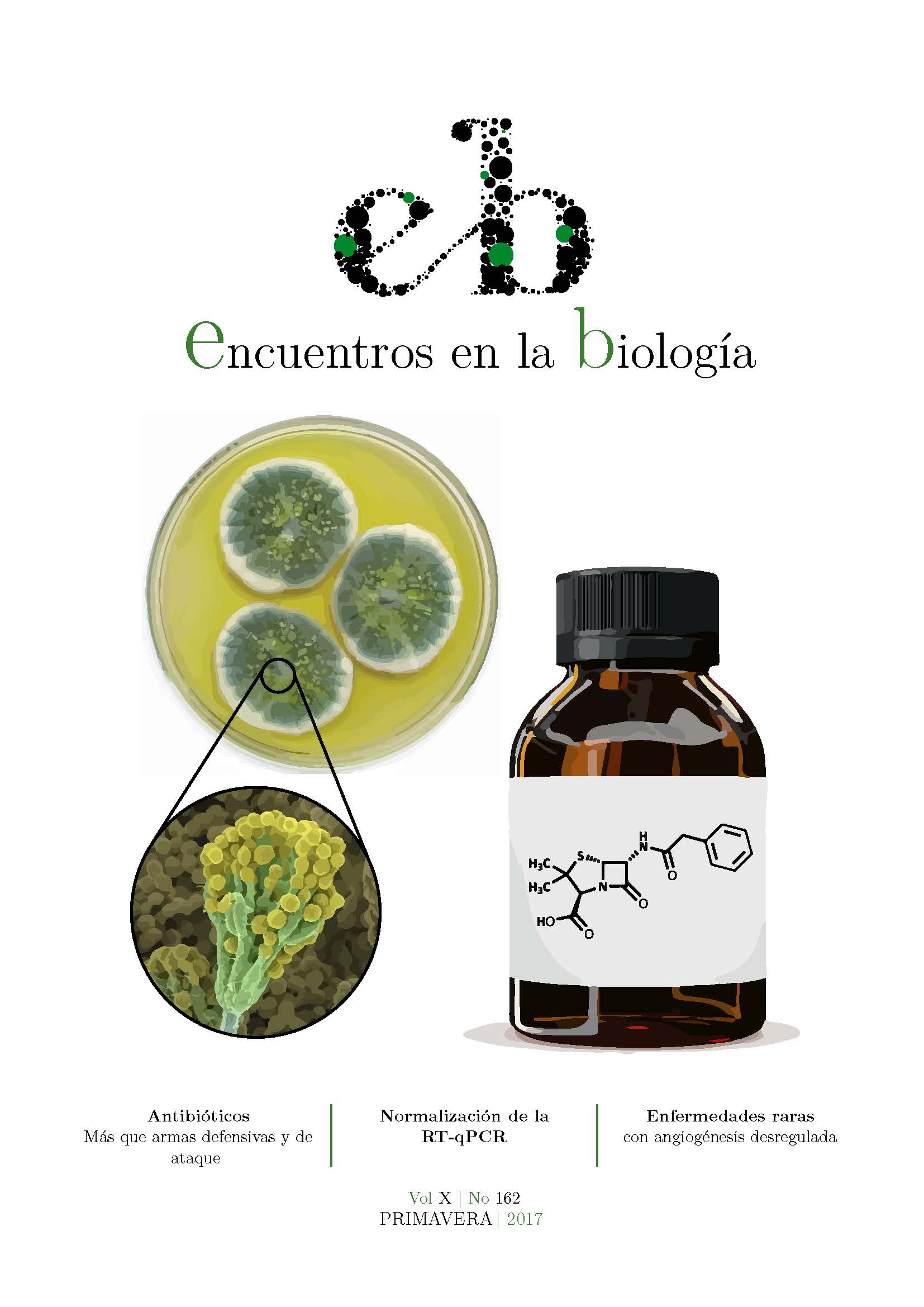
Antibiotics, something more than defensive and offensive weapons
Keywords:
antibiotics, homersis, biofilms, ecological fitnessAbstract
The discovery of antibiotics opened a new era in therapeutics reducing the number of people dead by infections. But antibiotics play other roles in the environment that enable the bacteria that produce them to increase their ecological fitness. Antibiotics exert different effects at concentrations below the inhibitory level playing a role in the hormesis process, that is, the ability of metabolites to induce different responses depending on its concentration. These responses range from production of biofilms to bacterial motility or nutritional functions. So, our human point of view of antibiotics should change.
Downloads
References
Thomashow LS y otros. Antibiotic production by soil and rhizosphere microbes in situ. In Manual of Environmental Microbiology, ed. CJ Hurst, GR Knudsen, MJ McInerney, LD Stetzenbach, MV Walter, pp. 493–99. Washington, DC: ASM Press. 1997.
Davies J. What are antibiotics? Archaic functions for modern activities. Mol. Microbiol. 4:1227–32. 1990.
Monier JM y otros. Metagenomic exploration of antibiotic resistance in soil. Curr. Opin. Microbiol. 14:229–35. 2011.
Allen HK y otros. Call of the wild:antibiotic resistance genes in natural environments. Nat. Rev. Microbiol. 8:251–59. 2010. 5Lopez D y otros. Structurally diverse natural products that cause potassium leakage trigger multicellularity in Bacillus subtilis. Proc. Natl. Acad. Sci. USA 106:280–85. 2009.
Lindow SE, Brandl MT. Microbiology of the phyllosphere. Appl. Environ. Microbiol. 69:1875–83. 2003.
Hernandez ME y otros. Phenazines and other redox-active antibiotics promote microbial mineral reduction. Appl. Envi- ron. Microbiol. 70:921–28. 2004.
Downloads
Published
Dimensions
Citations
Issue
Section
License
Esta obra está bajo licencia internacional Creative Commons Reconocimiento-NoComercial-CompartirIgual 4.0.
Esta revista provee acceso libre inmediato a su contenido bajo el principio de hacer disponible gratuitamente la investigación al público. Todos los contenidos publicados en Encuentros en la Bilogía están sujetos a la licencia Creative Commons Reconocimento-NoComercia-Compartirigual 4.0 cuyo texto completo puede consultar en <http://creativecommons.org/licenses/by-nc-sa/4.0>
Se pueden copiar, usar, difundir, transmitir y exponer públicamente, siempre que:
Se cite la autoría y la fuente original de su publicación (revista, editorial y URL de la obra).
No se usen para fines comerciales.
Se mencione la existencia y especificaciones de esta licencia de uso
Los derechos de autor son de dos clases: morales y patrimoniales. Los derechos morales son prerrogativas perpetuas, irrenunciables, intransferibles, inalienables, inembargables e imprescriptibles. De acuerdo con la legislación de derechos de autor, Encuentros en la Biología reconoce y respeta el derecho moral de los autores/as, así como la titularidad del derecho patrimonial, el cual será cedido a la Universidad de Málaga para su difusión en acceso abierto. Los derechos patrimoniales, se refieren a los beneficios que se obtienen por el uso o divulgación de las obras. Encuentros en la Biología se publica en open access y queda autorizada en exclusiva para realizar o autorizar por cualquier medio el uso, distribución, divulgación, reproducción, adaptación, traducción o transformación de la obra.
Es responsabilidad de los autores/as obtener los permisos necesarios de las imágenes que están sujetas a derechos de autor.
Los autores/as cuyas contribuciones sean aceptadas para su publicación en esta revista conservarán el derecho no exclusivo de utilizar sus contribuciones con fines académicos, de investigación y educativos, incluyendo el auto-archivo o depósito en repositorios de acceso abierto de cualquier tipo.
La edición electrónica de esta revista esta editada por la Editorial de la Universidad de Málaga (UmaEditorial), siendo necesario citar la procedencia en cualquier reproducción parcial o total.