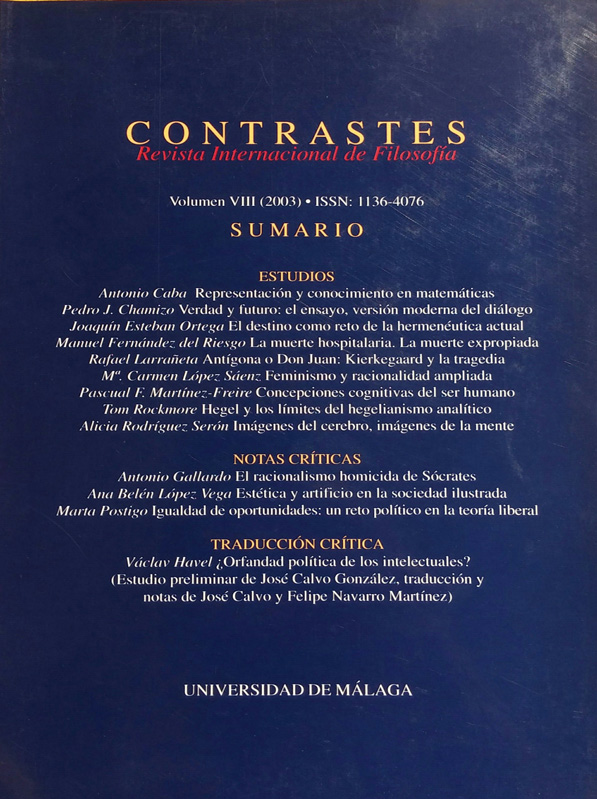
El racionalismo homicida de Sócrates
DOI:
https://doi.org/10.24310/Contrastescontrastes.v8i0.1844Palabras clave:
SÓCRATES-NIETZSCHE-RACIONALISMO-TRAGEDIAResumen
RESUMEN
Nietzsche con su habitual tono, radical y vehemente afirma que "todo el mundo conoce la tesis socrática, la virtus es el saber: se peca únicamente por ignorancia. El virtuoso es el feliz". En estas tres formas básicas del optimismo está la muerte de la tragedia, que es pesimista. Pues bien, todas estas circunstancia arrastran a Nietzsche a considerar a Sócrates como un homicida, es decir, un homicida racionalista que aniquila la tragedia al despojarla de su componente dionisiaco, irracional e imprevisible.
PALABRAS CLAVE
SÓCRATES-NIETZSCHE-RACIONALISMO-TRAGEDIA
ABSTRACT
Nietzsche with its habitual tone, vehement and radical affirms that the entire world knows the Socratic thesis; the virtue is the knowledge, to sin only by ignorance. The virtuous is happy. In these three basic forms of the optimism is the death of the tragedy, which is pessimistic. The, all these circumstances drag to Nietzsche to considerer to Socrates like a monicide, so a rationalist homicide that amihilates the tragedy when undressing it of its dionisiaco, irrational and unforeseeable component.
KEYWORDS
SOCRATES-NIETZSCHE-RATIONALISM-TRAGEDY
Descargas
Referencias
Descargas
Dimensions
Citations




Número
Sección
Licencia
Esta revista provee acceso libre inmediato a su contenido bajo el principio de hacer disponible gratuitamente la investigación al público. Todos los contenidos publicados en Contrastes. Revista internacional de Filosofía, están sujetos a la licencia Creative Commons Reconocimento-NoComercia-Compartirigual 4.0 cuyo texto completo puede consultar en <http://creativecommons.org/licenses/by-nc-sa/4.0>
Es responsabilidad de los autores/as obtener los permisos necesarios de las imágenes que están sujetas a derechos de autor.
Los autores/as cuyas contribuciones sean aceptadas para su publicación en esta revista conservarán el derecho no exclusivo de utilizar sus
contribuciones con fines académicos, de investigación y educativos,
incluyendo el auto-archivo o depósito en repositorios de acceso abierto de cualquier tipo.
La edición electrónica de esta revista esta editada por la Editorial de la
Universidad de Málaga (UmaEditorial), siendo necesario citar la procedencia en cualquier reproducción parcial o total.




5.png)
