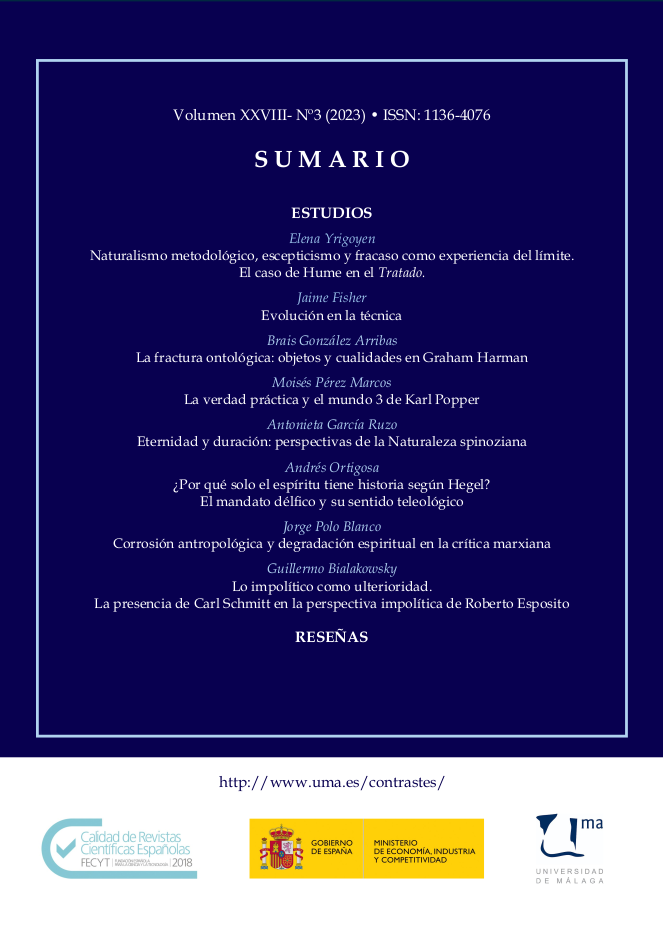
Evolución en la técnica
DOI:
https://doi.org/10.24310/Contrastescontrastes.v28i3.15374Palabras clave:
creatividad, invención, innovación, evolución, técnicaResumen
Conciliar los conceptos de creatividad, invención e innovación con el de evolución, al pensar la técnica, enfrenta un problema y una objeción entrelazados. El problema consiste en que los tres primeros implicarían un propósito o intencionalidad, mientras que el cuarto subsume un proceso ciego y carente de fines. De ahí la objeción a utilizar el modelo evolutivo darwinista en filosofía de la técnica. El propósito de este trabajo es proponer y defender la posibilidad de pensar fructíferamente sobre la evolución técnica -más allá de una mera metáfora-, sin dejar de utilizar los tres primeros conceptos señalados.
Descargas
Referencias
BALDWIN, J. M. 1896 «A New Factor in Evolution», The American Naturalist, 30, pp. 354-451, y 536-553.
BASALLA, G. 1988: The Evolution of Technology. Cambridge: Cambridge University Press.
BRENTANO, F. 1973 (1874): Psychology from an Empirical Standpoint. London: Routledge and Kegan Paul.
BRONCANO, F. 2000: Mundos Artificiales. México: UNAM-Paidós.
DAMASIO, A. 2005: En busca de Spinoza. Barcelona: Crítica.
DARWIN, C. 2009 (1876): The Origin of Species. Cambridge: Cambridge University Press.
DARWIN, C. 1887: F. Darwin (Ed.), The Life and Letters of Charles Darwin. Including an Autobiographical Chapter. New York: D. Appleton and Co.
DAWKINS, R. 1976: The Selfish Gene. Oxford: Oxford University Press.
DEWEY, J. 1925: Experience and Nature. Chicago: Open Court Publishing Compan.
DIÉGUEZ, A. (2011 b) «El origen evolutivo de la racionalidad humana», en A. R. Pérez, y A. Velasco (Coords.), Racionalidad en ciencia y tecnología. México: UNAM, pp. 179-191.
DOSI, G. 2000: Innovation, Organization and Economic Dynamics. Northampton: Edward Elgar.
EDELMAN, G. 1987: Neural Darwinism. The Theory of Neural Group Selection. New York: Basic Books.
FERRATER, J. 1979: De la materia a la razón. Madrid: Alianza.
HICKMAN, L. (1998) «Four Effects of Technology» Philosophy and Technology, 3, pp, 59-67.
HODGSON G. AND T. KNUDSEN (2006): «Why we need a generalized Darwinism, and why generalized Darwinism is not enough», Journal of Economic Behavior and Organization.
HUME, D. 2009 (1740): A Treatise of Human Nature. The Floating Press.
JABLONKA, E. AND LAMB, M. 2014: Evolution in Four Dimensions. Cambridge: The MIT Press.
LIBET, B. ET AL. (1983): «Time of Conscious Intention to Act in Relation to Onset of Cerebral Activity (Readiness-Potential). The Uncounscious Initiation of a Freely Voluntary Act», Brain, 106, pp. 623-642.
LIBET, B. ET AL. (1999): «Do We Have Free Will? » Journal of Consciousness Studies, (6), pp. 47-57.
OAKLEY, K. (1967): «Skill as a Human Possession», en Ch, Singer, and E. Holmyard , A History of Technology, Vol.1. Oxford University Press, pp. 1-37.
ORTEGA Y GASSET, J. 2015 (1939): Meditación de la técnica. Edición de Antonio Diéguez y Javier Zamora. Madrid: Biblioteca Nueva.
PINCH, T., AND BIJKER, W. (2012): «The Social Costruction of Facts and Artifacts» en Bijker, Hughes and Pinch (2012): The Social Construction of Technological Systems. Cambridge: The MIT Press, pp. 11-44.
POLANYI, M. (1962): «Tacit Knowledge: Its Bearing on Some Problems of Philosophy», Review of Modern Physics, 34 (4, Octubre), pp. 601-616.
QUEENAN, B., RYAN, T. J., GAZZANIGA M., AND GALLISTEL, CH. (2017): «On the research of time past: the hunt for the substrate of memory», Ann N. Y. Acad. Sci. 2017 May; 1396(1): 108–125. doi:10.1111/nyas.13348.
SEARLE J. 2001: Rationality in Action. Cambridge: The MIT Press.
SIMPSON, G (1953): «The Baldwin Effect», Evolution, 7, (2). pp. 110-117.
SMITH, M. R., AND MARX, L. 1994: Does Technology Drive History? Cambridge: The MIT Press.
WATSON, P. 2005: Ideas. A History from Fire to Freud. London: Weidenfeld and Nicolson.
WEGNER, D. 2002: The Illusion of Conscious Will. Cambridge: Bradford Books-MIT Press,
WINNER, L. 1977: Autonomous Technology. Cambridge: MIT Press.
Publicado
Dimensions
Citations




Número
Sección
Licencia
Esta revista provee acceso libre inmediato a su contenido bajo el principio de hacer disponible gratuitamente la investigación al público. Todos los contenidos publicados en Contrastes. Revista internacional de Filosofía, están sujetos a la licencia Creative Commons Reconocimento-NoComercia-Compartirigual 4.0 cuyo texto completo puede consultar en <http://creativecommons.org/licenses/by-nc-sa/4.0>
Es responsabilidad de los autores/as obtener los permisos necesarios de las imágenes que están sujetas a derechos de autor.
Los autores/as cuyas contribuciones sean aceptadas para su publicación en esta revista conservarán el derecho no exclusivo de utilizar sus
contribuciones con fines académicos, de investigación y educativos,
incluyendo el auto-archivo o depósito en repositorios de acceso abierto de cualquier tipo.
La edición electrónica de esta revista esta editada por la Editorial de la
Universidad de Málaga (UmaEditorial), siendo necesario citar la procedencia en cualquier reproducción parcial o total.




5.png)
