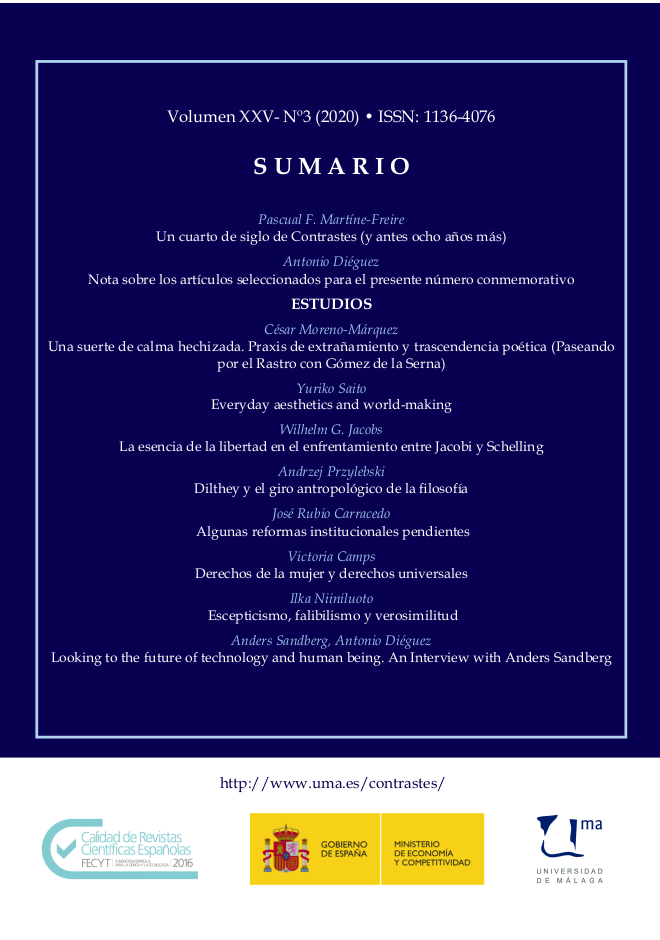
Escepticismo, falibilismo y verosimilitud
DOI:
https://doi.org/10.24310/Contrastescontrastes.v25i3.11574Palabras clave:
falibilismo epistémico, historia del escepticismo, variedades del escepticismo, verosimilitudResumen
En la epistemología moderna, el falibilismo es una vía media entre el dogmatismo y el escepticismo. Su origen histórico se encuentra en una rama de la antigua escuela del escepticismo académico. Ya que la diferencia entre las formas fuerte y débil del falibilismo, así como la distinción entre probabilidad epistémica y verosimilitud, sólo han sido comprendidas en las últimas dos décadas, no podemos esperar encontrar formulaciones claras de dichas doctrinas entre los filósofos griegos y romanos. Pero hemos mostrado que las dos ideas centrales del falibilismo –el grado de certeza y el grado de cercanía a la verdad– están presentes en la tradición escéptica al menos desde los tiempos de Cicerón.
Descargas
Referencias
AGASSI, J. (1963) Towards a Historiography of Science, The Hague: Mouton.
ANDREW, D. (1984) Concepts in Film Theory, Oxford: Oxford University Press.
AGUSTINE, St. (1950) Against the Academics, Westminister: The Newman Press.
BAUDRILLARD, J. (1984) «The Precession of Simulacra», in B. Wallis (ed), Art After Modernism: Rethinking Representation, New York: The New Museun of Contemporary Art, pp. 253-281.
BETT, R. (1989) «Carneades’ Pithanon: A Reappraisal of its Role and Status», in J. Annas (ed), Oxford Studies in Ancient Philosophy, Oxford: Oxford University Press, pp. 59-94.
BRADLEY, F. H. (1983) Appearance and Reality, London: George Allen.
BURNYEAT, M. (1980) «Can the Sceptic Live His Scepticism?», in Schofield et al., pp. 20-53. Reimpreso en Burnyeat (1983), pp. 117-148.
BURNYEAT, M. (ed) (1983) The Skeptical Tradition, Berkeley: University of California Press.
BYRNE, E. (1968) Probability and Opinion: A Study of Medieval Presuppositions of Post-Medieval Theories of Probability, The Hague: M. Nijhoff.
CARNAP, R. (1971) «Inductive Logic and Rational Decisions», in R. Carnap y R. Jeffrey (eds), Studies in Inductive Logic and Probability, vol. I, Berkeley: University of California Press, pp. 5-31.
CICERÓN (1956) De naura deorum, Academica, London: William Heinemann.
COPLESTON, F. (1966) A History of Philosophy, vol. I, London: Burns and Oates.
COUISSIN, P. (1983) «The Stoicism of the New Academy», in Burnyeat (1983), pp. 31-63.
CUSA, N. de (1954) Of Learned Ignorance, London: Routledge and Kegan Paul.
CHISHOLM, R. (1977) Theory of Knowledge, Englewood Cliffs: Prentice Hall.
DEWEY, J. (1960) The Quest for Certainty, New York: Capricorn Books.
DUHEM, P. (1969) To Save the Phenomena: An Essay on the Idea of a Physical Theory from Plato to Galileo, Chicago: The University of Chicago Press.
EWING, A. C. (1934) Idealism: A Critical Survey, Strand: Methuen.
FEYERABEND, P. (1984) «Xenophanes: A Foreruner of Critical Rationalism?», in G. Andersson (ed), Rationality in Science and Politics, Dordrecht: Reidel, pp. 95-109.
FEYERABEND, P. (1987) Farewell to Reason, London: Verso.
GARBER, D. y ZABELL, S. (1979) «On the Emergence of Probability», Archive for History of Exact Sciences 21, 33-53.
GLUCKER, J. (1995) «Probabile, Veri Simile, and Related Terms», in J.G.F. Powell (ed), Cicero the Philosopher, Oxford: Oxford University Press, pp. 115-143.
GOLDMAN, A. I. (1986) Epistemology and Cognition, Cambridge, Ma.: Harvard University Press.
HACKING, I. (1975), The Emergence of Probability, Cambridge: Cambridge University Press.
JAMES, W. (1956) The Will to Believe and Other Essays in Popular Philosophy, New York: Dover.
JARDINE, L. (1983) «Lorenzo Valla: Academic Skepticism and the New Humanist Dialectic», in Burnyeat (1983), pp. 253-286
JEFFREY, R. (1984) «De Finetti’s Probabilism», Synthese 60, 73-90.
KANT, I. (1974) Logic, Indianapolis: Bobbs-Merrill.
KANTOLA, I. (1994) Probability and Moral Uncertainty in Late Medieval and Early Modern Times, Helsinki: Luther-Agricola-Society.
KIRWAN, C. (1983) «Agustine against the Skeptics», in Burnyeat (1983), pp. 205-224.
LAUDAN, L. (1973) «Peirce and the Trivialization of the Self-Corrective Thesis», in R. Giere and R. Westfall (ed), Foundations of Scientific Method: The Nineteenth Century, Bloomington: Indiana University Press, pp. 275-306.
LAUDAN, L. (1981) Science and hypothesis, Dordrecht: Reidel.
LAUDAN, L. (1984) Science and Values, Berkeley: University of California Press.
LEHRER, K. (1990) Theory of Kowledge (Boulder: Westview).
LEEUWEN, H. G. van (1970) The problem of Certainty in English Thought 1630-1690, Amsterdam: Nijhoff.
LEVI, I. (1967) Gambling With Truth, New York: Alfred A. Knopf.
LONG, A. A. (1986) Hellenistic Philosophers: Stoics, Epicureans, Sceptics, 2nd ed., Berkeley: University of California Press.
LONG, A. A. y SEDLEY, D. N. (eds) (1988), The Hellenistic Philosophers, Cambridge: Cambridge University Press.
LYOTARD, J.-F. (1985) The Postmodern Condition: A Report on Knowledge, Minneapolis: University of Minnesota Press.
MEHTONEN, P. (1996) Old Concepts and New Poetics: Historia, Argumentum, and Fabula in the Twelfth- and Early Thirteenth-Century Latin Poetics of Fiction, Helsinki: Societas Scientiarum Fennica.
MUSGRAVE, A. (1993) Common Sense, Science and Scepticism, Cambridge: Cambridge University Press.
NIINILUOTO, I. (1977) «On the Truthlikeness of Generalizations» in R. E. Butts y J. Hintikka (eds), Basic Problems in Methodology and Linguistic, Logic, Methodology, and Philosophy of Science V, Part Three, Dordrecht: Reidel,
pp. 121-147.
NIINILUOTO, I. (1978) «Notes on Popper as Follower of Whewell and Peirce», Ajatus 37, pp. 272-327. Reimpreso en Niiniluoto (1984), pp. 18-60.
NIINILUOTO, I. (1984) Is Science Progressive?, Dordrecht: Reidel.
NIINILUOTO, I. (1987) Truthlikeness, Dordrecht: Reidel.
NIINILUOTO, I. (1997) Critical Scientific Realism, (en prensa).
NIINILUOTO, I. y TUOMELA, R. (1973) Theoretical Concepts and Hypothetico- Inductive Inference, Dordrecht: Reidel.
ODDIE, G. (1986) Likeness to Truth, Dordrecht: Reidel.
PAPPAS, G y SWAIN, M. (eds) (1978) Essays on Knowledge and Justification, Ithaca: Cornell University Press.
PEIRCE, C. S. (1931-35) Collected Papers, vols. 1-6 ed. por C. Hartshorne y P. Weiss, Cambridge, MA.: Harvard University Press.
POPKIN, R. H. (1979) The History of Scepticism from Erasmus to Spinoza, Berkeley: University of California Press.
POPPER, K. R. (1963) Conjectures and Refutations, London: Routledge and Kegan Paul.
POPPER, K. R. (1979) Objective Knowledge, ed. rev., Oxford: Oxford University Press.
QUINE, W. v. O. (1960) Word and Object, Cambridge, MA.: The MIT Press.
RESCHER, N. (1973) The Coherence Theory of Truth, Oxford: Oxford University
Press.
RORTY, R. (1984) «The Historiography of Philosophy: Four Genres», in R. Rorty, J. B. Schneewind y Q. Skinner (eds), Philosophy in History, Cambridge: Cambridge University Press, pp. 49-75.
RORTY, R. (1989) Contingency, Irony, and Solidarity, Cambridge: Cambridge University Press.
SCOFIELD, M., BURNYEAT, M. y BARNES, J. (eds) (1980) Doubt and Dogmatism: Studies in Hellenistic Epistemology, Oxford: Oxford University Press.
SELLARS, W. (1968) Science and Metaphysics, London: Routledge and Kegan Paul.
SEXTUS EMPIRICUS (1985) Selections from the Major Writings on Scepticism, Man, and God, ed. por P. P. Hallie, Indianapolis: Hackett
IHVOLA, J. (1996) «Vakuuttavat vaikutelmat: antiikin skeptisismi ja tiedon mahdollisuus», in T. M. Holopainen y T. J. Holopainen (eds), Sielun liikkeitä, Helsinki: Gaudeamus, pp. 59-68.
SUPPES, P. (1981) «Limitations of the Axiomatic Method in Ancient Greek Mathematical Sciences», in J. Hintikka, D. Gruender y E. Agazzi (eds), Theory Change, Ancient Axiomatics, and Galileo’s Methodology, Dordrecht: Reidel, pp. 197-213.
STRIKER, G. (1980) «Sceptical Strategies», in Scofield et al., pp. 54-83.
TODOROV, T. (1977) The Poetics of Prose, Oxford: Blackwell.
UNGER, P. (1975) Ignorance: A Case for Scepticism, Oxford: Oxford University Press.
VAN FRAASSEN. B. (1980) The Scientific Image, Oxford: Oxford University Press.
WATKINS, J. (1984) Science and Scepticism, Princenton: Princentom University Press.
Descargas
Publicado
Dimensions
Número
Sección
Licencia
Esta revista provee acceso libre inmediato a su contenido bajo el principio de hacer disponible gratuitamente la investigación al público. Todos los contenidos publicados en Contrastes. Revista internacional de Filosofía, están sujetos a la licencia Creative Commons Reconocimento-NoComercia-Compartirigual 4.0 cuyo texto completo puede consultar en <http://creativecommons.org/licenses/by-nc-sa/4.0>
Es responsabilidad de los autores/as obtener los permisos necesarios de las imágenes que están sujetas a derechos de autor.
Los autores/as cuyas contribuciones sean aceptadas para su publicación en esta revista conservarán el derecho no exclusivo de utilizar sus
contribuciones con fines académicos, de investigación y educativos,
incluyendo el auto-archivo o depósito en repositorios de acceso abierto de cualquier tipo.
La edición electrónica de esta revista esta editada por la Editorial de la
Universidad de Málaga (UmaEditorial), siendo necesario citar la procedencia en cualquier reproducción parcial o total.
Cómo citar








5.png)
