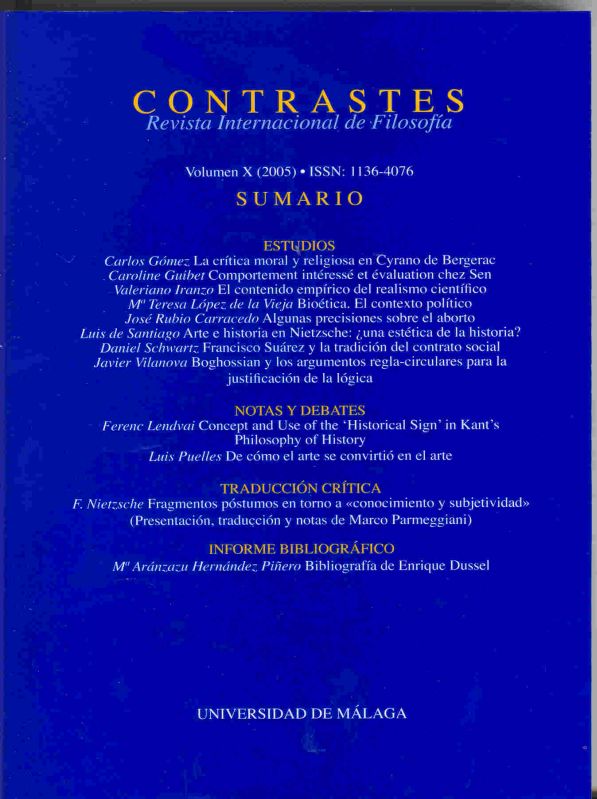
Arte e historia en F. Nietzsche: ¿Una estética de la historia?
DOI:
https://doi.org/10.24310/Contrastescontrastes.v0i0.1884Palabras clave:
HISTORIA-ESTÉTICA-SABER ARTÍSTICO-NIETZSCHEResumen
RESUMEN
Este artículo trata de explicar cómo en Nietzsche se puede hablar de una concepción estética de la historia como una nueva alternativa a la concepción científica de la historia y a su pretensión de objetividad. Lo verdaderamente importante es dejar entrever o ver la profundidad de sentido, poder y belleza que hay detrás de cada uno de los hechos históricos. El historiador, como un "gran potencia artística", debería ser capaz de elevarse por encima de las cosas, ir más allá de ellas, proclamando ese saber artístico que reclama la necesidad de la apariencia, para poder seguir viviendo mediante la transformación del pasado.
PALABRAS CLAVE
HISTORIA-ESTÉTICA-SABER ARTÍSTICO-NIETZSCHE
ABSTRACT
This paper tries to explain how in Nietzsche one could speak from an aesthetics conception of the history like a new alternative to the scientific conception of the history and its pretense of objetivity. The truly important thing is to allow to see the sense depth, power and beauty that there is behind each one of the historical facts. The historian, like a "great artistic power", it should be able to rise above the things, to go beyond them, proclaiming that artistic knowledge that claims the neccessity of the appearance, to be able to continue living by means of the transformation of the past.
KEYWORDS
HISTORY-AESTHETICS-TO KNOW ARTISTIC-NIETZSCHE
Descargas
Referencias
Descargas
Dimensions
Citations




Número
Sección
Licencia
Esta revista provee acceso libre inmediato a su contenido bajo el principio de hacer disponible gratuitamente la investigación al público. Todos los contenidos publicados en Contrastes. Revista internacional de Filosofía, están sujetos a la licencia Creative Commons Reconocimento-NoComercia-Compartirigual 4.0 cuyo texto completo puede consultar en <http://creativecommons.org/licenses/by-nc-sa/4.0>
Es responsabilidad de los autores/as obtener los permisos necesarios de las imágenes que están sujetas a derechos de autor.
Los autores/as cuyas contribuciones sean aceptadas para su publicación en esta revista conservarán el derecho no exclusivo de utilizar sus
contribuciones con fines académicos, de investigación y educativos,
incluyendo el auto-archivo o depósito en repositorios de acceso abierto de cualquier tipo.
La edición electrónica de esta revista esta editada por la Editorial de la
Universidad de Málaga (UmaEditorial), siendo necesario citar la procedencia en cualquier reproducción parcial o total.




5.png)
