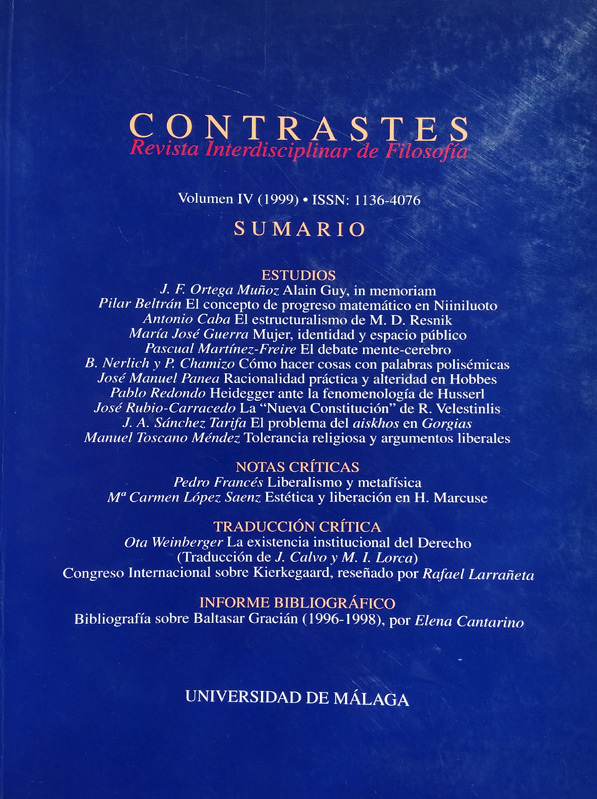
El problema del aiskhos en Gorgias
DOI:
https://doi.org/10.24310/Contrastescontrastes.v4i0.1262Resumen
RESUMEN
La introducción que Platón hace en Gorgias de cada nuevo interlocutor se interpreta, por quien sustituye al anterior, como una rendición por aiskhos (vergüenza) frente a Sócrates. Los estudios clásicos han entendido que la pretensión de Platón es mostrar paso a paso lo que se oculta tras la apariencia de la retórica, y por eso hace más radicales a sus representantes, para conseguir la asociación inconsciente en la mente del lector de que tras la máscara de Gorgias se esconde Calicles. Sin embargo, según nuestra interpretación, Platón no deseaba tanto mostrarnos la faz oculta de la retórica cuando combatir tres rentes retóricos que partían de distintos presupuestos sobre la moral.
PALABRAS CLAVE
PLATÓN-GORGIAS-RETÓRICA-SOFISTA
ABSTRACT
In Gorgias the introduction Plato makes of each new interlocutors is interpreted by the successive speaker as a surrender on the part of the prvious one due to aiskhos (shame) before Socrates' arguments. Classical studies have explanied that Plato aims to show step by step what is hidden under the appearance of Rhetoric. That is why he makes its representatives more radical in order to produce, in the reader's mind, the unconcious association that Callicles is hidden behind Gorgias' mask. Neverthless, according to our interpretation, Plato did not intend to show us the hidden face of rhetoric but to combat three rhetorical fronts wich originated in different moral assumptions.
KEYWORDS
PLATO-GORGIAS-RHETORIC-SOPHIST
Descargas
Referencias
Descargas
Dimensions
Citations




Número
Sección
Licencia
Esta revista provee acceso libre inmediato a su contenido bajo el principio de hacer disponible gratuitamente la investigación al público. Todos los contenidos publicados en Contrastes. Revista internacional de Filosofía, están sujetos a la licencia Creative Commons Reconocimento-NoComercia-Compartirigual 4.0 cuyo texto completo puede consultar en <http://creativecommons.org/licenses/by-nc-sa/4.0>
Es responsabilidad de los autores/as obtener los permisos necesarios de las imágenes que están sujetas a derechos de autor.
Los autores/as cuyas contribuciones sean aceptadas para su publicación en esta revista conservarán el derecho no exclusivo de utilizar sus
contribuciones con fines académicos, de investigación y educativos,
incluyendo el auto-archivo o depósito en repositorios de acceso abierto de cualquier tipo.
La edición electrónica de esta revista esta editada por la Editorial de la
Universidad de Málaga (UmaEditorial), siendo necesario citar la procedencia en cualquier reproducción parcial o total.




5.png)