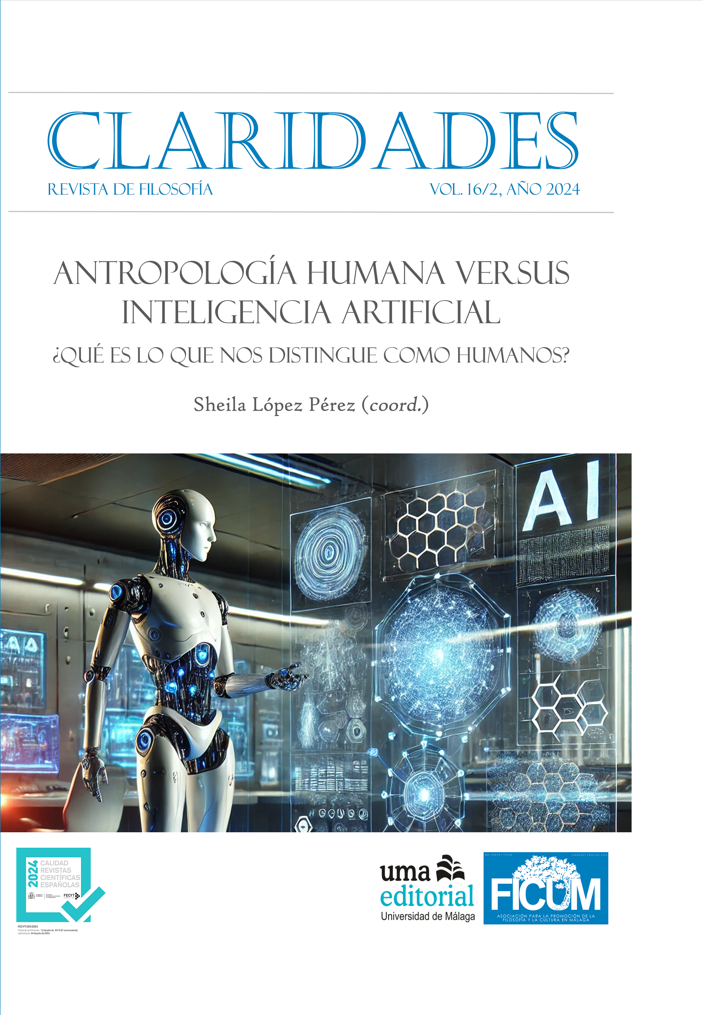
Singularity? Limitations, possibilities, and differences of artificial intelligence compared to human intelligence
DOI:
https://doi.org/10.24310/crf.16.2.2024.19654Keywords:
artificial intelligence, cognotivism, neuroscience, consciousness, embodied cognitionAbstract
In this paper, we reflect on whether AI has reached the level of human intelligence, some of the reasons that lead us to that state of opinion, as well as on some of the fundamental differences between AI and human intelligence. We briefly review the historical development of AI and delineate the real capacities and important limitations of deep learning techniques, underlying most of the recent advancements in AI. We particularly explain the argument of how complex cognitive skills are inseparable from a biological body interacting with a physical and socio-cultural world. This view contradicts the dualist and cognitivist axiom on which IA is fundamentally based, which has been criticized as incomplete or partial. We finalize considering some current real risks of AI and some speculations on its future development.
Downloads
References
Altman, S. [en línea]: «Moore’s law for everything», en Sam Altman (2021). https://moores.samaltman.com [Consultado: 02/04/2024].
Blank, I. A. (2023): «What are large language models supposed to model? », Trends in Cognitive Sciences, 27(11), pp. 987–989. doi: 10.1016/j. tics.2023.08.006.
Brödner, P. (2019): «Coping with Descartes’ error in information systems», AI and Society, 34(2), pp. 203–213. doi: 10.1007/s00146-018
-8.
Bush, V. [en línea]: «As we may think», en Life (1945). https://www. theatlantic.com/magazine/archive/1945/07/as-we-may-think/303881/ [Consultado: 02/04/2024].
Chomsky, N., Roberts, I., & Watumull, J. [en línea]: «The false promise of Chat-GPT» en The New York Times (2023). https://www.nytimes.
com/2023/03/08/opinion/noam-chomsky-chatgpt-ai.html [Consultado: 02/04/2024].
Cooban, A. [en línea]: «AI investment is booming. How much is hype?» en CNN (2023). https://edition.cnn.com/2023/07/23/business/
ai-vc-investment-dot-com-bubble/index.html [Consultado: 26/03/2024].
Damasio, A. (1994): Descartes’ error: Emotion, reason, and the human brain. New York City: Putnam.
Damasio, A., & Carvalho, G. B. (2013): «The nature of feelings: Evolutionary and neurobiological origins», Nature Reviews Neuroscience,
(2), pp. 143–152. doi: 10.1038/nrn3403.
Damasio, A., & Meyer, K. (2009): «Consciousness: An overview of the phenomenon and of its possible neural basis», en Laureys, S. y Tononi, G. (eds) The neurology of consciousness. San Diego: Elsevier, pp. 1–14. doi: 10.1016/B978-0-12-374168-4.00001-0.
Davis, E., & Marcus, G. (2015): «Commonsense reasoning and commonsense knowledge in artificial intelligence», Communications of the ACM, 58(9), pp. 92–103. doi: 10.1145/2701413.
de Saint Laurent, C. (2018): «In defence of machine learning: Debunking the myths of artificial intelligence», Europe’s Journal of Psychology, 14(4), pp. 734–747. doi: 10.5964/ejop.v14i4.1823.
Despres, J. [en línea]: «Scenario: Shane Legg» en Future (2008). https:// tinyurl.com/hwzna364 [Consultado: 02/04/2024]
Dreyfus, H. (1973): «Crítica de la razón artificial», Diálogos: Artes, Letras, Ciencias Humanas, 9(1), pp. 11–18.
Dreyfus, H. (2007): «Why Heideggerian AI failed and how fixing it would require making it more Heideggerian», Philosophical Psychology, 20(2), pp. 247–268. doi: 10.1080/09515080701239510.
Fjelland, R. (2020): «Why general artificial intelligence will not be realized», Humanities and Social Sciences Communications, 7(1), pp. 1–9. doi: 10.1057/s41599-020-0494-4.
Foglia, L., & Wilson, R. A. (2013): «Embodied cognition», Wiley Interdisciplinary Reviews: Cognitive Science, 4(3), pp. 319–325. doi:
1002/wcs.1226.
Future of Life Institute [en línea]: Pause Giant AI Experiments: An Open Letter. Future of Life Institute (2023). https://futureoflife.org/open-letter/pause-giant-ai-experiments/ [Consultado: 26/03/2024].
Geirhos, R. et al. (2020): «Shortcut learning in deep neural networks», Nature Machine Intelligence, 2(11), pp. 665–673. doi: 10.1038/s42256020-00257-z.
Giattino C., Mathieu E., Samborska, V. y Roser, M. [en línea]: «Artificial Intelligence», en Our World in Data (2023). https://ourworldindata.org/artificial-intelligence [Consultado: 26/03/2024].
Gill, K. S. (2019): «From judgment to calculation: the phenomenology of embodied skill: Celebrating memories of Hubert Dreyfus and Joseph Weizenbaum», AI and Society, 34(2), pp. 165–175. doi: 10.1007/s00146
-00884-0.
Gottfredson, L. S. (1997): «Mainstream science on intelligence: An editorial with 52 signatories, history, and bibliography», Intelligence, 24(1), pp. 13–23. doi: 10.1016/S0160-2896(97)90011-8.IBM [en línea]: «701 Translator», en IBM Press Release (1954). https://
tinyurl.com/2vbkr22w [Consultado: 28/03/2024].
Jiang, Y. et al. (2022): «Quo vadis artificial intelligence?», Discover Artificial Intelligence, 2(1). doi: 10.1007/s44163-022-00022-8.
Korteling, J. E. y Hans. et al. (2021): «Human- versus Artificial Intelligence», Frontiers in Artificial Intelligence, 4, pp. 1–13. doi: 10.3389/
frai.2021.622364.
LaGrandeur, K. (2023): «The consequences of AI hype», AI and Ethics, (0123456789), pp. 1–4. doi: 10.1007/s43681-023-00352-y.
Leaver, T., & Srdarov, S. (2023): «ChatGPT Isn’t Magic», M/C Journal, 26(5), pp. 1–6. doi: 10.5204/mcj.3004.
Lighthill J. (1973): «Artificial intelligence: a general survey», en Artificial Intelligence: a paper symposium. Brooklyn: Science Research Council.
López de Mántaras, R. (2017): «Algunas reflexiones sobre el presente y el futuro de la Inteligencia Artificial», Revista de Occidente, 436, pp. 57–72.
López de Mántaras, R. (2020): «El traje nuevo de la inteligencia artificial», Investigación y ciencia, 526, pp. 52–59.
Man, K., & Damasio, A. (2019): «Homeostasis and soft robotics in the design of feeling machines», Nature Machine Intelligence, 1(10), pp. 446–452. doi: 10.1038/s42256-019-0103-7.
McCarthy, J., Minsky, M. L., Rochester, N., & Shannon, C. E. (2006): «A proposal for the Dartmouth Summer Research Project on Artificial
Intelligence, August 31, 1955», AI Magazine, 27(4), p. 12. doi: 10.1609/aimag.v27i4.1904.
McCracken, H. [en línea]: «Inside Mark Zuckerberg’s bold plan for the future of Facebook», en Fast Company (2015). www.fastcompany.com/3052885/mark-zuckerberg-facebook [Consultado: 02/04/2024].
Mitchell, M. (2021): «Why AI is harder than we think» ArXiv. doi: 10.1145/3449639.3465421.
Mitchell, M. (2024): «Debates on the nature of artificial general intelligence», Science, 383(6689): doi: 10.1126/science.ado7069.
Modis, T. (2006): «The singularity myth», Technological Forecasting and Social Change, 73(2), pp. 104–112. doi:10.1016/j.techfore.2005.12.004.
Natale, S. y Ballatore, A. (2020): «Imagining the thinking machine: Technological myths and the rise of artificial intelligence», Convergence, 26(1), pp. 3–18. doi: 10.1177/1354856517715164.
National Science and Technology Council [en línea]: Preparing for the future of artificial intelligence. Executive Office of the President. https://obamawhitehouse.archives.gov/sites/default/files/whitehouse_files/microsites/ostp/NSTC/preparing_for_the_future_of_ai.pdf [Consultado: 01/04/2024].
Newell, A., & Simon, H. A. (1976): «Computer science as empirical inquiry», Communications of the ACM, 19(3), pp. 113–126. doi:
1145/360018.360022.
Nilsson, N. J. (2006): «Human-level artificial intelligence? Be serious!», AI Magazine, 26(4), pp. 68–75.
Okidegbe, N. (2022): «The democratizing potential of algorithms?», Connecticut Law Review, 53, pp. 1–47.
Pilling, F., & Coulton, P. (2019): «Forget the singularity, its mundane artificial intelligence that should be our immediate concern», Design Journal, 22(sup1), pp. 1135–1146. doi: 10.1080/14606925.2019.1594979.
Ranaweera, M. y Mahmoud, Q. H. (2021): «Virtual to real-world transfer learning: A systematic review», Electronics, 10(12). doi: 10.3390/
electronics10121491.
Raviv, L., Lupyan, G., & Green, S. C. (2022): «How variability shapes learning and generalization», Trends in Cognitive Sciences, 26(6),
pp. 462–483. doi: 10.1016/j.tics.2022.03.007.
Ribeiro, M. T., Singh, S., & Guestrin, C. (2016): «“Why should I trust you?” explaining the predictions of any classifier», Conference of the North American Chapter of the Association for Computational Linguistics: Human. Language Technologies, Proceedings of the Demonstrations Session, pp. 97–101. doi: 10.18653/v1/n16-3020.
Searle, J. R. (1980): «Minds, brains, and programs», Behavioral and Brain Sciences, 3(3), pp. 417–424. doi: 10.1017/S0140525X00005756.
Silver, D. et al. (2018): «A general reinforcement learning algorithm that masters chess, shogi, and Go through self-play», Science, 362(6419), pp. 1140–1144. doi: 10.1126/science.aar6404.
Turing, A. (1950): «Computing machinery and intelligence», Mind, LIX(236), pp. 433–460. doi: 10.1093/mind/LIX.236.433.
Woolaston, V. [en línea]: «We’ll be uploading our entire minds to computers by 2045 and our bodies will be replaced by machines within 90 years, Google expert claims», en Daily Mail (2013). https://tinyurl.com/ht44uxzv [Consultado: 02/04/2024].
Downloads
Published
Dimensions
Citations




Issue
Section
License
Copyright (c) 2024 Pablo Carrera
Esta revista provee acceso libre inmediato a su contenido bajo el principio de hacer disponible gratuitamente la investigación al público. Todos los contenidos publicados en Claridades. Revista de Filosofía, están sujetos a la licencia Creative Commons Reconocimento-NoComercia-Compartirigual 4.0 cuyo texto completo puede consultar en <http://creativecommons.org/licenses/by-nc-sa/4.0>
Es responsabilidad de los autores/as obtener los permisos necesarios de las imágenes que están sujetas a derechos de autor.
Los autores/as cuyas contribuciones sean aceptadas para su publicación en esta revista conservarán el derecho no exclusivo de utilizar sus
contribuciones con fines académicos, de investigación y educativos, incluyendo el auto-archivo o depósito en repositorios de acceso abierto de cualquier tipo.
La edición electrónica de esta revista esta editada por la Editorial de la Universidad de Málaga (UmaEditorial), siendo necesario citar la procedencia en cualquier reproducción parcial o total.






6.png)
