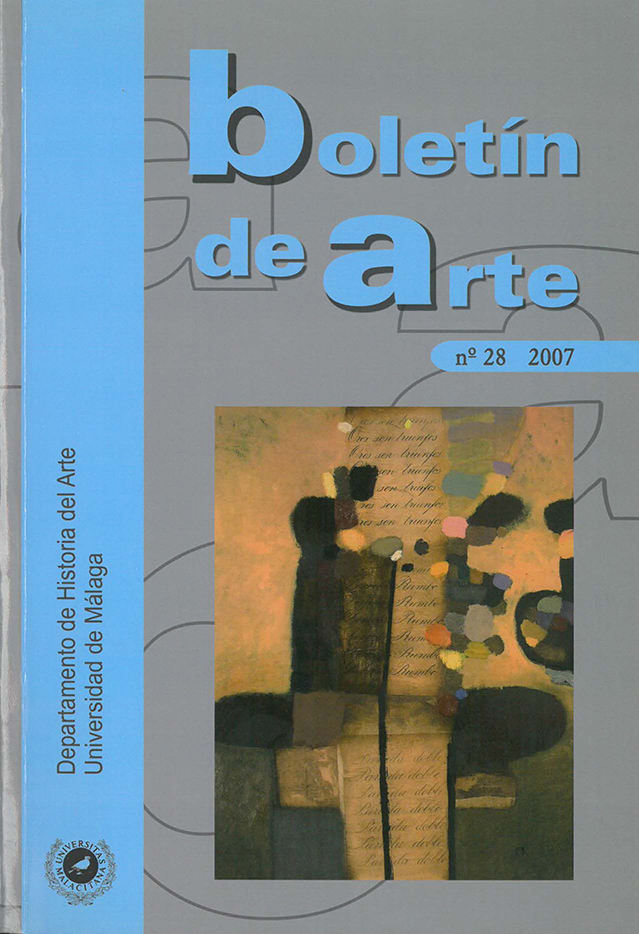
Joaquín Peinado. Neocubista y lírico (1924-1930)
DOI:
https://doi.org/10.24310/BoLArte.2007.v0i28.4489Abstract
Till now, to speak about Joaquín Peinado was Spanish School of Paris to do it of one of the most representative painters of one badly understood, and badly named; of a follower of the cubism who used the geometric forms and estilemas of the famous ismo to realize works of great epidermal figurative and conceptual abstract sense; of a “pro-form” art. But there was, before this one, another Peinado. A painter that, in the shade of the decorative cubism of Picasso, I take to his linens a “new” cubism; a neo-cubism who, mixed with blasts of return to the order and adorned with drops of surrealism, it led, together with Bores, Viñes, Cossío, González de la Serna, Gischia, Estevé, Beaudin or Menkes, to the lyric figuration called.
Downloads
References
Downloads
Published
Dimensions
Citations




Issue
Section
License
Todos los contenidos publicados en la revista Boletín de Arte están sujetos a la licencia Creative Commons Reconocimento-NoComercia-Compartirigual 4.0 cuyo texto completo puede consultar en <http://creativecommons.org/licenses/by-nc-sa/4.0>

Los/as autores/as cuyas contribuciones sean aceptadas para su publicación en esta revista conservarán el derecho no exclusivo de utilizar sus contribuciones con fines académicos, de investigación y educativos, incluyendo el auto-archivo o depósito en repositorios de acceso abierto de cualquier tipo.
La edición electrónica de esta revista esta editada por la Editorial de la Universidad de Málaga (UmaEditorial), siendo necesario citar la procedencia en cualquier reproducción parcial o total.





4.png)
